Why Skill-Based Education Is Important for Students in 2026
Why Skill-Based Education Is Important for Students in 2026

Blog 1
Blog Date : 10-08-2026
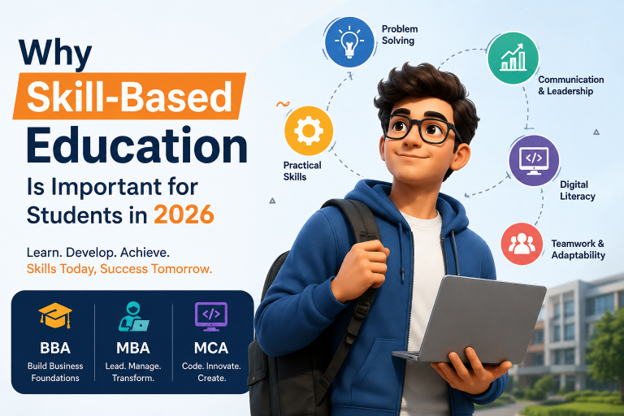
The world of education and employment is changing rapidly. In 2026, academic qualifications alone are no longer enough to build a successful career. Employers increasingly look for graduates who can apply their knowledge, solve real-world problems, communicate effectively, and adapt to new technologies while learning. This is why skill-based education has become an important part of modern higher education.
For students planning their careers, choosing a course that combines academic knowledge with practical skills can provide a strong foundation for educational and professional growth. Programs such as BBA, BCA, MBA, and MCA can help students develop industry-relevant knowledge while preparing them for the demands of the modern workplace.
What Is Skill-Based Education?
Skill-based education focuses on developing practical abilities along with theoretical knowledge. Instead of simply memorizing concepts, students learn how to use what they study in real-life situations. Depending on the course, students may develop skills such as:
- Communication and presentation
- Leadership and teamwork
- Problem-solving and decision-making
- Digital and technical skills
- Data analysis
- Business and management skills
- Programming and software development
- Creativity and innovation
- Project management
This approach helps students become more confident and better prepared for internships, jobs, entrepreneurship, and higher studies.
Why Is Skill-Based Education Important in 2026?
1. Changing Industry Requirements
Technology is transforming almost every industry. Artificial intelligence, automation, data analytics, cloud computing, digital marketing, and other technologies are changing the way organizations work.
Companies need professionals who can understand these changes and use modern tools effectively. Skill-based education helps students develop the practical knowledge required to keep pace with evolving industries.
2. Better Career Readiness
One of the biggest advantages of skill-based education is that it prepares students for the workplace.
Students get opportunities to work on projects, presentations, case studies, practical assignments, and other activities that can simulate real professional situations. This experience can make the transition from college to employment smoother.
3. Helps Students Build Confidence
Knowing a concept theoretically is different from knowing how to apply it. When students regularly participate in practical activities, they become more confident in using their knowledge.
For example, a management student may learn about marketing strategies in class and then apply those concepts while developing a marketing plan. Similarly, a computer application student can strengthen programming knowledge by working on software projects.
4. Develops Communication and Soft Skills
Employers value more than technical knowledge. Communication, teamwork, leadership, adaptability, and time management are equally important in professional life.
Skill-based learning provides students with opportunities to participate in group projects, seminars, presentations, discussions, and other activities that help improve these essential soft skills.
Skill-Based Learning Through BBA
A BBA (Bachelor of Business Administration) can be a suitable choice for students interested in business, management, marketing, finance, human resources, or entrepreneurship.
Along with business concepts, BBA students can develop practical skills through:
- Business case studies
- Marketing projects
- Presentations
- Business communication
- Entrepreneurship activities
- Team-based assignments
- Industry-oriented projects
These experiences can help students understand how businesses operate and prepare them for different career opportunities.
Building Advanced Management Skills Through MBA
An MBA (Master of Business Administration) provides students with advanced knowledge of business and management. In today's competitive environment, MBA students can benefit significantly from practical and skill-oriented learning.
An MBA program can help students strengthen skills such as:
- Strategic decision-making
- Leadership
- Business analytics
- Financial management
- Marketing strategy
- Human resource management
- Project management
- Entrepreneurship
Combining management theory with practical learning can help MBA graduates become better prepared to handle professional responsibilities.
Developing Technical Skills Through MCA
For students interested in technology and computer applications, MCA (Master of Computer Applications) can provide opportunities to develop advanced technical knowledge.
A skill-oriented MCA education can focus on areas such as:
- Programming and software development
- Web and application development
- Database management
- Cloud technologies
- Data analytics
- Artificial intelligence
- Cybersecurity
- Software project management
Practical projects and hands-on learning can help MCA students understand how technical concepts are applied to real-world problems.
Skill-Based Education and Employability
Employability is one of the major reasons students should focus on developing practical skills. A degree demonstrates academic achievement, while practical skills demonstrate what a student can actually do.
Students who combine their academic qualifications with relevant skills can improve their readiness for:
- Internships
- Campus placements
- Corporate careers
- Freelancing
- Higher education
- Industry certifications
Building a strong portfolio of projects, certifications, internships, and practical experiences can also help students demonstrate their abilities to potential employers.
The Role of Colleges in Skill Development
Colleges play an important role in helping students develop industry-relevant skills. A modern educational institution should provide students with opportunities to learn beyond textbooks.
Activities such as workshops, seminars, internships, industry interactions, practical projects, guest lectures, competitions, and placement training can complement classroom education.
Students should also take responsibility for their own skill development by learning new technologies, attending professional events, building projects, and continuously improving their communication and professional abilities.
Conclusion
In 2026, education is becoming increasingly focused on knowledge plus skills. Students need more than a degree to succeed in a competitive professional environment. They need practical abilities, technological awareness, communication skills, problem-solving capabilities, and the confidence to apply their knowledge.
Programs such as BBA, MBA, and MCA can provide students with strong academic foundations while skill-based learning can help them prepare for real-world professional challenges.
For students planning their future, the right combination of education, practical experience, and continuous skill development can be the key to building a successful and sustainable career.
Learn today. Build skills. Prepare for tomorrow.